

How Japanese “Planning” and Chinese “Flexibility” Create the Best Teams
Japan and China are neighboring countries that often feel both close and distant. When comparing Japanese and Chinese national characteristics in the business world, a common contrast is the “planning-oriented” nature of Japanese people and the “flexibility-oriented” nature of Chinese people.* At first glance, these traits may seem completely opposite and even prone to conflict. However, at HighChem, Japanese and Chinese employees have successfully formed highly harmonious teams and consistently delivered outstanding results over many years.
Blending two materials with different characteristics to create new value—this is precisely the concept behind polymer alloys, one of the fields in which HighChem, as a chemical manufacturer, excels.
Why is HighChem able to generate synergy that transcends cultural differences? In this edition of our Business Etiquette Series, we interviewed Mr. Li, General Manager, who has led Japan-China mixed teams for many years. He shares his management philosophy as a “compatibilizer (bridge)”, connecting different personalities and transforming them into the strongest possible team.
For all business professionals who face challenges in managing diverse teams, this article offers valuable insights into building exceptional teams.
* This perspective is based on personal experience.
Blending two materials with different characteristics to create new value—this is precisely the concept behind polymer alloys, one of the fields in which HighChem, as a chemical manufacturer, excels.
Why is HighChem able to generate synergy that transcends cultural differences? In this edition of our Business Etiquette Series, we interviewed Mr. Li, General Manager, who has led Japan-China mixed teams for many years. He shares his management philosophy as a “compatibilizer (bridge)”, connecting different personalities and transforming them into the strongest possible team.
For all business professionals who face challenges in managing diverse teams, this article offers valuable insights into building exceptional teams.
* This perspective is based on personal experience.
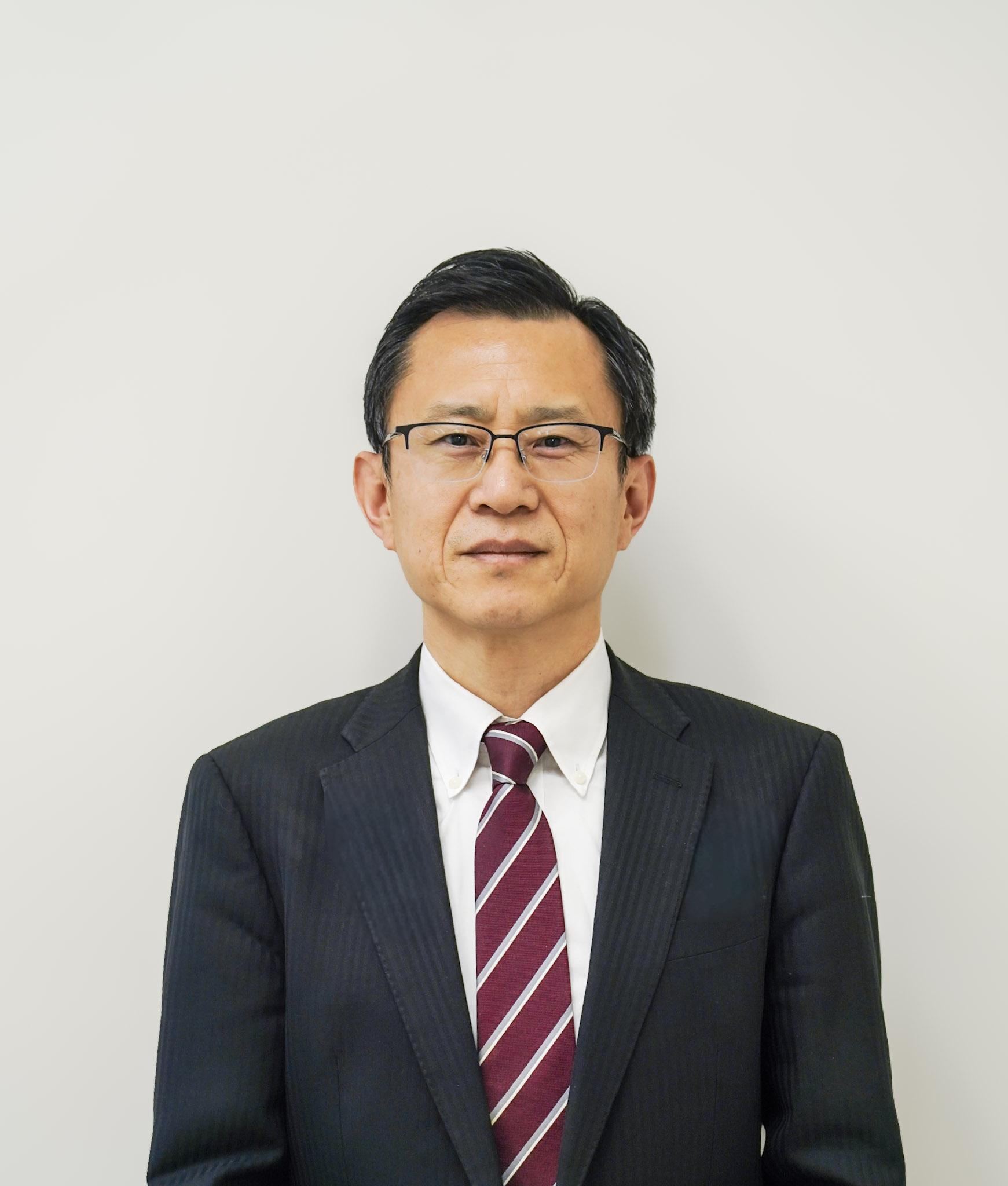
Today’s interviewees:
Material Research Office, Business Support Office, Mr. Li
After graduating from a university in China, Mr. Li pursued graduate studies in Japan and earned a Ph.D. in the field of organic materials. He then spent 15 years working as a researcher at a major Japanese chemical manufacturer before joining HighChem in 2012. He currently serves as General Manager of the Materials Research Office under the Sustainability & Innovation Division, while also holding the position of General Manager of the Business Support Office under the Trade Division.
Case 1: “Veteran Japanese Employees” and “Young Chinese Employees”

The Sales Support Office overseen by Mr. Li includes approximately 20 senior Japanese employees who have built successful careers at major chemical manufacturers and other leading companies. Having accumulated more than 30 years of experience at major Japanese corporations, these senior employees are indispensable to HighChem, where approximately 70% of the workforce is Chinese. They play a significant role in passing on Japanese business practices and developing younger talent. Mr. Li is responsible for managing these senior employees, and we asked him about the secrets of successful management in this challenging environment.
— When forming a team consisting of “veteran Japanese employees” and “young Chinese employees,” what do you keep in mind?
Mr. LiMy role as a manager is less about management itself and more about helping both sides understand each other’s perspectives and positions.
Although it has become less common in recent years, there were times when senior Japanese employees held strict views toward younger Chinese colleagues and expressed those opinions directly. In such situations, I would first show understanding toward their concerns and then explain, “They are still growing as working professionals. Rather than speaking so directly, please take the time to carefully teach them your way of doing things.”
Many of our younger employees begin their professional careers at HighChem immediately after graduating from universities in China. It is unrealistic to expect them to fully understand Japanese business customs from the outset. What is “common sense” to senior Japanese employees is not necessarily “common sense” to them. That is why I often tell our senior employees, “Please try to understand them first, show them gradually, and take the time to develop them carefully.”
Because of this, it may be more accurate to describe my role as a “coordinator.” By responding to concerns and consultations from both sides and providing careful support little by little, situations often improve significantly.
— I see. Having someone who truly understands both perspectives must make it easier for everyone to work with peace of mind.
Mr. Li That’s right. I receive this kind of consultation email almost every day. I believe that is largely because I have built relationships with our senior employees in which we can speak openly and honestly about anything.
They are true professionals in their respective fields. All of them have extensive experience and are fully capable of working independently. Therefore, my role is to provide an environment in which they can work comfortably—in other words, a platform. I always try to offer advice and suggestions that help them utilize their talents and achieve results at HighChem.
For senior employees as well, having spent most of their careers in Japanese society, suddenly entering a unique workplace where 70% of their colleagues are Chinese can naturally create anxiety. This kind of support is especially important during the period immediately after joining the company.
— Is there anything you pay particular attention to when listening to senior employees?
Mr. LiMost of our senior employees are older than I am and have much more experience, so my basic attitude is one of “respect.” They are truly my seniors in life.
Even if I am their manager, our relationship is ultimately one between people. By consistently maintaining an attitude of addressing issues when necessary while respecting them as individuals, I feel that they have gradually come to understand and accept my approach.
We Asked Mr. Li! What Cultural Gaps Has Mr. Li Experienced Between Japan and China?
— You came to Japan 30 years ago. Could you tell us about the differences between Japan and China that you first noticed?
Mr. Li When I arrived in Japan 30 years ago, there was still a significant economic gap between Japan and China, and everything felt fresh and new to me.
The biggest culture shock I experienced was how clearly people draw boundaries between themselves and others. In other words, there is a strong awareness of “not causing inconvenience to others” and a culture of maintaining a certain distance between individuals. I felt this was very different from what we Chinese are accustomed to.
The experience that left the strongest impression on me occurred when I was conducting experiments in a university laboratory. In China, it is natural for friends to help one another. For example, during overnight experiments, it would be normal to watch a friend’s equipment and record data on their behalf.
When I was in the third year of my doctoral program in Japan, I asked a senior student for help in the same way I would have in China. He did what I asked, but the following day he asked me to help him with something else. At the time, I felt a little puzzled and thought, “Why is he asking me to do something he could do himself?” Later, after thinking about it carefully, I suddenly realized that perhaps it was his way of saying that favors should be returned.
Perhaps people in Japan do not casually rely on others for help. At that moment, I understood for the first time that avoiding inconvenience to others and maintaining clear boundaries between oneself and others are very important elements of Japanese culture. Japan is certainly a country that values teamwork, but I believe it is also a society where individuals maintain very clear personal boundaries.
— Do you think Chinese people do not have the same sense of boundaries?
Mr. Li Yes. In China, there is a deeply rooted concept of “helping one another,” and people tend to have a somewhat more relaxed view that even if someone causes a little inconvenience, the favor will be returned someday.
Case 2: “Japanese Researchers” and “Chinese Researchers”
— In the field of research, where you have spent much of your career, what differences do you see between Japanese and Chinese researchers?
Mr. Li There are certainly differences in research as well, particularly in the approach to experimentation.
Japanese researchers carefully document experimental processes and naturally regard those records as valuable company assets. Chinese researchers, on the other hand, often have a stronger results-oriented mindset. Their highest priority is completing the experiment and achieving results, while the process itself tends to receive less attention.
As a result, experiments conducted by Japanese researchers generally have high reproducibility, whereas experiments conducted by Chinese researchers can sometimes be difficult to reproduce. The reason lies in differences in the quality of documentation. In chemistry, maintaining detailed laboratory notebooks is extremely important, and this can sometimes be a challenge for Chinese researchers.
At the same time, one of the greatest strengths of Chinese researchers is their creativity and ability to generate ideas. Experiments often do not go as planned, but even when they encounter obstacles, Chinese researchers tend to respond flexibly with new ideas. This flexibility can sometimes lead to unexpected discoveries and breakthroughs.
— It sounds as though a team combining Japanese and Chinese researchers could produce outstanding results.
Mr. Li Exactly. However, the reality is that achieving this is not always easy. Researchers tend to be very honest and straightforward people. (laughs) Many are not inclined to completely change their own style, whether they are Japanese or Chinese. Everyone has their own approach and naturally believes their way is the right one. (laughs) Considering that many researchers have completed doctoral programs, that is only natural.
From my perspective, the only thing we can do is patiently and persistently encourage both sides to understand each other’s viewpoints.
Conclusion: How Can Japanese and Chinese People Build the Best Team?
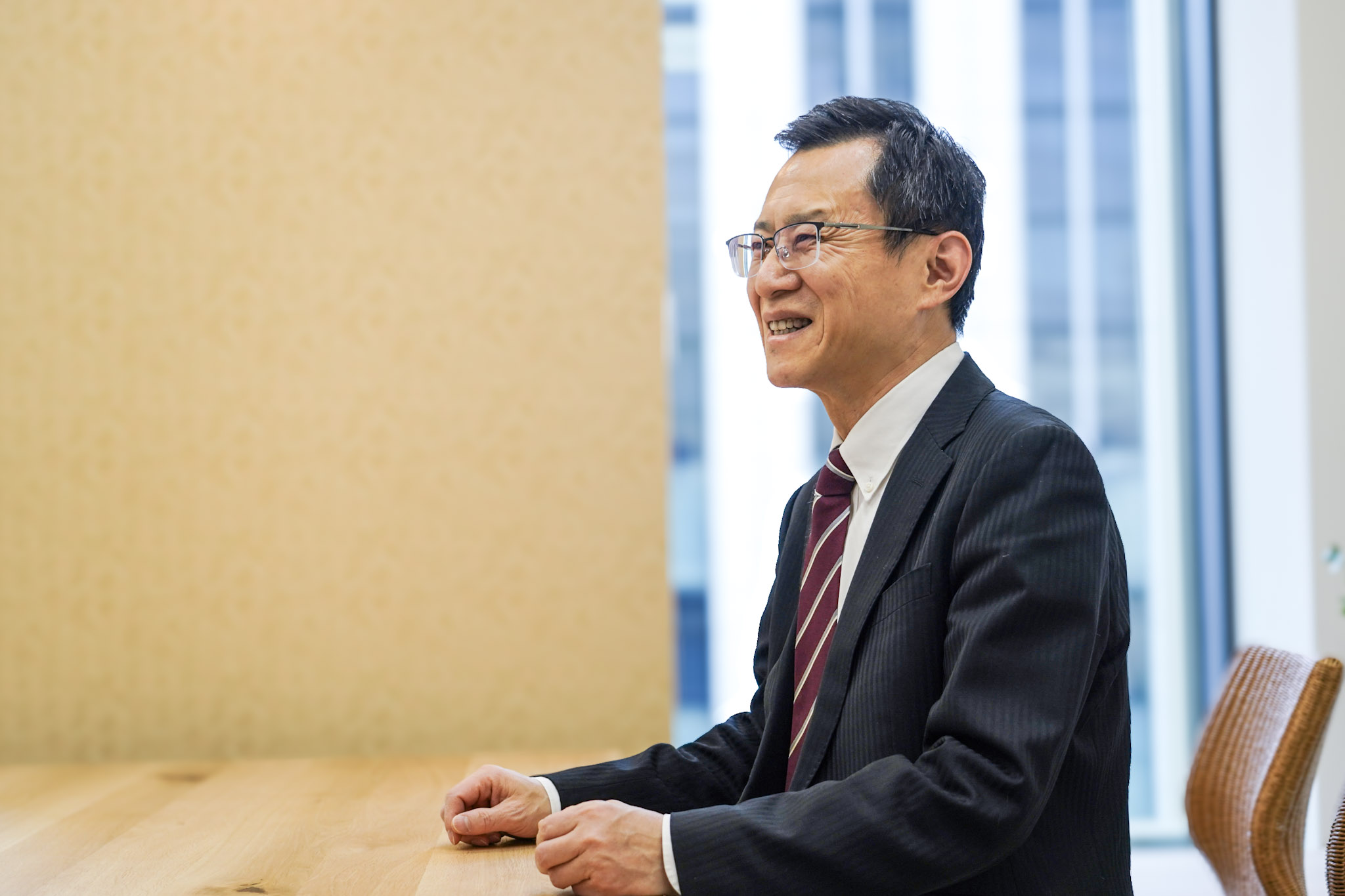
— What do you believe is the key to creating the best possible team?
Mr. Li Let me talk a little about my area of expertise. My specialty is polymers. In that field, there is a concept called a “polymer alloy.” Simply put, it refers to creating a new material with new properties by combining Material A and Material B. However, simply mixing A and B together does not necessarily work. The materials may repel each other and fail to blend properly. That is why additives are used to help the two materials combine successfully. In many ways, I believe my role is similar to that of such an additive.
In our industry, this type of additive is known as a “compatibilizer.” By introducing a substance with characteristics completely different from either material, it becomes possible to create unity and generate synergistic effects.
However, simply adding any additive is not enough. If the wrong additive is selected, the combined effect of A and B may actually become negative. Therefore, a compatibilizer must be an effective one—capable of helping A and B integrate successfully and produce significant results together.
At HighChem, we refer to the role of this compatibilizer as a “BRIDGE.” It is difficult to change Material A or Material B themselves. Likewise, it is not easy to change people who come from entirely different cultural backgrounds. That is why, for a group of people with different cultural backgrounds to achieve outstanding teamwork, success depends largely on how effectively the “additive” performs its role.
Turning diversity into a strength—this is the very essence of team management in the global era.


